How to Spot Genuine Handmade Ceramics at a Craft Market
The bowls on the first table are lined up like soldiers: identical height, identical curve, identical hard white glare. On the second table the same shape appears six times, and no two sit quite the same way. Both sellers will tell you the work is handmade. Learning to tell the difference takes an afternoon of looking closely — at the base of a pot, at the way light moves across a glaze, and at what the person behind the stall can actually tell you about the kiln.
Pick It Up: Weight, Rim, and Foot
The first test costs nothing and takes five seconds: lift the piece. A hand-thrown mug of a given size often has a touch more heft than a slip-cast one, because the wall thickness is set by the potter's fingers rather than by the minimum a mould allows. It isn't a rule you can weigh, but the difference is usually there in the hand.
Now run your thumb around the rim. A thrown rim tends to be slightly thicker than the wall just below it and may be a little uneven — a rise or dip you can feel but not see. A cast rim is thin, glassy and identical the whole way round. Then turn the piece over and study the foot ring, the raised circle the pot stands on. On a thrown pot that ring was usually turned on the wheel with a loop tool, so you'll find a crisp edge, a shallow cut line, sometimes faint chatter marks where the tool bounced against the clay. Cast feet are smooth, rounded and dead even.
One warning: ignore the old trick of tapping the rim and listening for a ring. The note depends on thickness and firing temperature, not on how the pot was made. It tells you almost nothing.
Read the Glaze
Glaze is where handmade and mass-produced look most alike, and also where they part company under close inspection. On a dipped piece, glaze pools in the recesses and thins over rims and edges, so the clay shows through as a paler line. Look for a drip that ran and stopped in a bead, a scatter of pinholes, a slightly wavy edge where the glaze stops above the foot, and sometimes a wiped thumbprint where the potter held the pot while dipping.
Factories can imitate all of that, and often do. What they find harder is genuine randomness: two "matching" mugs where the glaze breaks differently, a cluster of speckles that appears on one side only, a colour that shifts where the wall thickens.
Crazing — the fine web of cracks across a glaze — is not automatically a fault. It can happen over years and some potters create it deliberately, rubbing a dark stain into a crackle glaze. Ask instead of assuming. And be wary of printed decoration: zoom in with your phone camera. Halftone dots, a decal edge you can feel with a fingernail, a motif repeated with mechanical precision — all point to a transfer rather than a brush. Hand-painted lines wobble, thicken and thin.
Check the Base and the Mark
Turn it over again. Most potters mark their work somewhere on the base: initials scratched in with a needle tool, a small stamp pressed into the clay, a painted cipher, sometimes a year or a batch number. An incised mark was cut before firing, so its edges are slightly sharp or raised and the glaze has pooled inside it. A printed backstamp sits on top of the surface, flat and sometimes flaky enough to lift with a nail.
No mark does not mean no maker. Plenty of good potters leave early work unsigned, and a sticker reading "handmade" is marketing copy, not evidence of process — anyone can have labels printed. What matters is whether the seller can tell you who made the piece and how. If a stall holds fifty pieces marked identically and identical in size, ask how the batch was made. There is a legitimate answer: a potter who slip-casts from their own moulds is still a potter, and plenty of respected studios work that way. The problem is only ever the pretending.
Look for the Traces of the Wheel
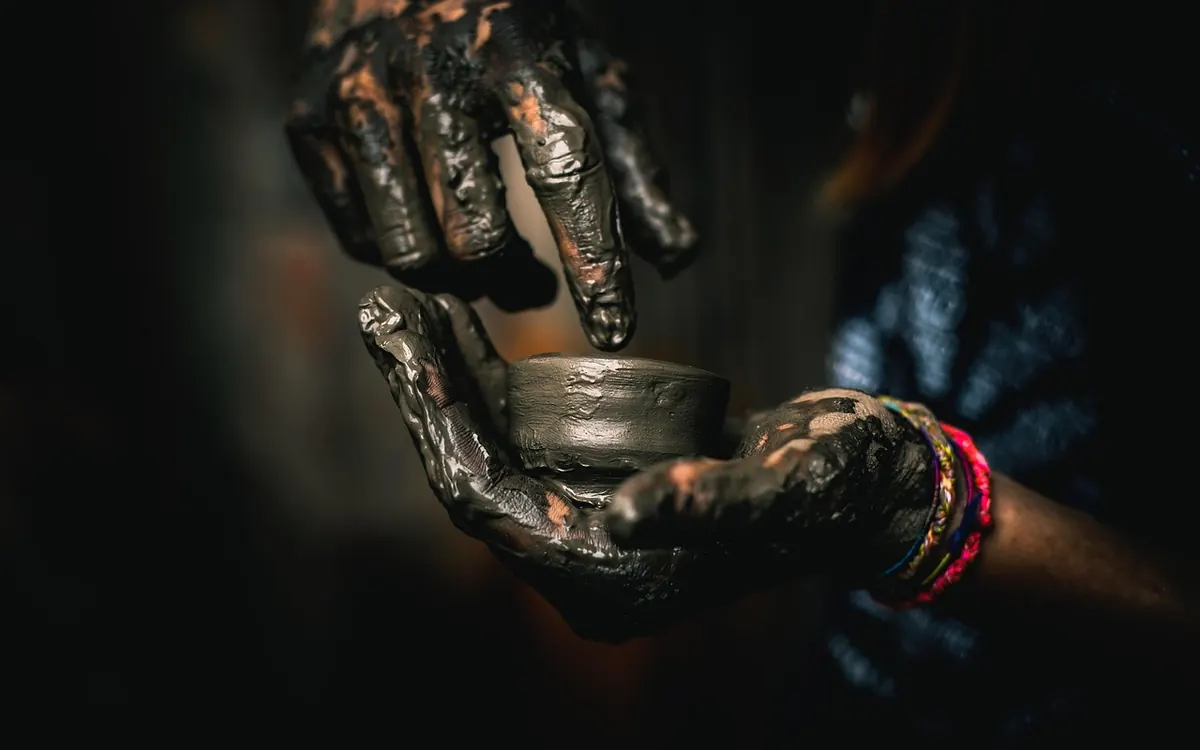
Inside a thrown vessel you will usually find horizontal rings left by fingertips, a spiral at the bottom where the potter finished the base, sometimes a slight dimple in the centre. Handles pulled from a lump of clay taper, carry a thumb indent, and are blended in at the top and bottom where you can feel the join. Spouts, knobs and lugs are attached with slip and leave a faint seam. Cast pieces are smooth inside, uniformly thick, and show none of it.
Keep an eye out for the giveaways of industrial production:
- A fine raised mould line running down the side, often near a handle or spout.
- A base that is completely flat and smooth, with no foot ring at all.
- Three tiny spur marks on the glazed base, left by stilts in a kiln — informative rather than damning on its own.
- Perfect repetition across twenty pieces: identical rims, identical handles, identical glaze breaks.
- A join between body and base that looks glued rather than made, or visible screws and rivets.
- Decoration that stops with a hard, printed edge instead of fading into the glaze.
But be fair about symmetry. A skilled thrower can make twelve cups that match closely — that is the skill, not a confession. Wobble is not a certificate of authenticity, and a straight rim is not proof of a factory.
Ask the Questions That Have Answers
One specific, polite question usually settles it. Ask something a maker answers without thinking:
- What clay is this — stoneware, earthenware, porcelain — and roughly what temperature is it fired to?
- Did you throw this yourself, or is it slab-built or cast in a mould?
- Is the glaze one you mix yourself?
- Is the glaze food-safe, and is it dishwasher-safe?
- What happens if it chips — can it be repaired?
The point is not to interrogate anyone's technical knowledge. It is to hear whether the answers are concrete and quick. A maker will happily tell you which glaze crawled in the last firing or which handle they cut off and re-did. A reseller of factory seconds repeats the label. If a piece is meant for food, ask directly whether the glaze is food-safe and lead-free; low-fired earthenware deserves the question. If the seller can't answer and the pot is for daily use or for a child, choose another piece.
Before You Pay: A Two-Minute Check
Lift it, turn it over, read the glaze, feel the foot. Then check that it actually works: a plate should sit flat without rocking, a mug should balance when full, a lid should seat without wobble. Run a fingernail along handle joins and rims for hairline cracks. Small chips and seconds are perfectly good buys when they are declared and priced as such.
Finally, take the maker's name and a card if there is one. The most reliable way to buy genuine handmade work is to buy it twice from the same person, and the second visit is easier than the first. If you love a piece, start with one and live with it for a while. The best pottery usually carries a small imperfection the maker chose to keep — and a story about why. Ask about it. It is often the best part of the purchase.
Photo: gorkhe1980 / Pixabay


You Might Also Like
A practical guide to building your own day route through local markets, small producers and craft workshops, with realistic timing, tasting tips and a schedule that survives real life.
Farmers markets win on freshness and producer contact; specialty shops win on variety, convenience and curation. Here is how to choose the right source for each purchase.